White keyboard with question marks around it

Frequently Asked Questions

Navigating the application process for Lawyers Professional Liability Insurance can be complex. Our FAQ section is designed to provide clear and comprehensive answers to common questions you might have. Contact us if you have any questions.

Coverage Basics

Yes! Professional liability insurance (PLI) can provide your law firm with a defense in the event a claim is filed against you, whether an error was made or not. Should a claim occur, PLI coverage may provide you with access to a defense attorney seasoned in lawyer’s malpractice claims caused by:

  • administrative errors,
  • unintentional negligence,
  • missed deadlines,
  • alleged misrepresentation,
  • inaccurate advice,
  • alleged baseless charges, and so on.

Access to this type of support when dealing with a malpractice claim can help eliminate the loss of time and money (and not to mention stress) that defending a claim requires. Having someone on your side to offer advice and answer questions is invaluable.

Many states require lawyers to disclose whether they carry malpractice insurance. Some states may require clients to sign a written disclosure acknowledging that the attorney is practicing without professional liability insurance coverage. Requiring potential clients to sign these disclosures may cause them to question working with you. Or you may practice in a state that requires PLI. Oregon and Idaho, for example, currently require attorneys to carry professional liability coverage. Just more reasons why yes, you do need professional liability insurance.

Lawsuits can happen, frivolous or not. Without adequate coverage protecting your firm, a lawsuit could be so costly that it leaves your business in ruins.

If a client suffers damages, they may sue you to make themselves whole. Professional liability insurance can provide protection against potential severe financial impact, emotional turmoil, and reputational harm. It can cover your legal defense and indemnity* in the event that an unexpected issue arises, and may provide you with defense counsel and the financial support required to handle the lawsuit. That way, you can continue to run your law practice without the distraction of handling the claim yourself. Depending on the policy, coverage may extend to court fees, administrative costs, witnesses, mediation, judgments, settlements, or other related expenses you could easily incur as a result of a claim.

Professional liability coverage can also protect your work for years to come. Most policies provide a free “tail” (Extended Reporting Period) after years of continuous coverage upon retirement. So even after you retire, there may be coverage for your past acts*. In addition, most coverage could also apply to other attorneys in the firm or non-attorney staff, keeping your entire organization protected from legal malpractice claims.

Extended Reporting Period Guide

Risks typically covered by a professional liability policy include*:

  • Inadequate work
  • Mistakes or negligence
  • Personal injury
  • Previously performed services
  • Work performed by your employees

Risks typically not covered by a professional liability policy include:

  • Dishonesty
  • Employment matters such as workplace injuries
  • False advertising
  • Fraudulent or criminal acts
  • General liability claims, such as bodily injury or property damage
  • Intentional acts or harm

Because professional liability insurance is written on a “claims-made and reported” basis, you will want to obtain coverage for your firm as early as possible in your legal career.

“Claims-made and reported” means the claim must occur and be reported during the policy period. Your retroactive date, or prior acts date, is the date upon which you first obtained coverage. When a lawyer has prior acts coverage, malpractice issues that occur after the retroactive date are usually covered* as long as the matter was reported in compliance with the policy. On the other hand, any alleged malpractice that happened prior to the retroactive date would be excluded from coverage, even if reported during a current policy term.

So, you will want to have coverage in place as soon as possible because you will need to have a policy in place when the error occurs and the claim is reported (or coverage may not apply).

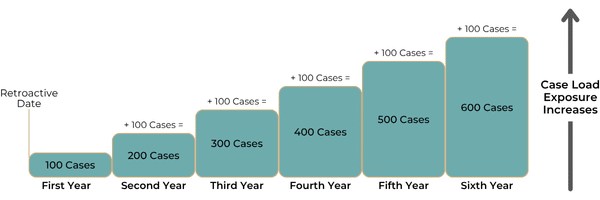
A retroactive date, or prior acts date, is the date upon which coverage was first in place on a claims-made policy. It indicates to the underwriter how many years of exposure the carrier will be taking on if terms are offered.

To elaborate, when you obtain coverage (when no prior coverage is currently in place), the retroactive date will be the date of the inception of the firm’s first claims-made policy. The exposure to the carrier regarding past acts is minimal at this point. The policy will only provide coverage on a go-forward basis. However, at each renewal, the exposure borne by the carrier will increase as past exposure increases.

In tandem with the increased exposure, the premium will also increase for a set number of years until it reaches the “mature premium” level. All admitted carriers must file these “step rate factors” with the state’s insurance regulators. An insured will see an increase in premium commensurate with the increased exposure for anywhere from 5 to 8 years, depending on the carrier and state.

Visual of Prior Acts Step-Rate Factors**:

**The chart above does not precisely represent step rate years, as LPL insurance carriers will differ in the number of years required to mature premiums. This chart is not intended to depict any specific policy.

A retroactive date is the date from which your insurance coverage starts. Think of it like you are drawing a line in the sand. Any events or incidents that happen after this date are covered by your policy. However, events that occurred before this date are generally not covered.

A prior acts date is the date when your insurance policy begins, regardless of when you actually purchased the policy. It provides protection against claims for events that occurred before the policy started but after the retroactive date.

The main difference is that the retroactive date determines what events are covered going forward, while the prior acts date determines when your coverage begins for events that happened before your policy started.

How to Better Understand Insurance Coverage

A claims-made policy requires coverage to be in place at the time a claim is reported, and the incident must occur after the retroactive date. A claims-made and reported policy requires that you report any claim or potential claim during the policy period in which you received notice of the claim. If a claim is made after the policy expires or is canceled, it may not be covered unless an extended reporting period (tail coverage) is purchased. Professional liability insurance is written on a claims-made and reported policy form.

An occurrence policy provides protection for incidents that occurred during the policy period, regardless of when a claim or incident is reported. Even if the policy is no longer in effect, the incident during the policy period may be covered as long as the claim is made within the statute of limitations.

Claims-Made Vs. Occurrence Insurance Policies Explained

Claims-Made and Reported Policies 101

Extended Reporting Period Guide

Policy Premiums

Many factors can determine your annual premium, and rates may differ between carriers.

Some key premium factors are:

  • areas of practice,
  • state and county where you are located,
  • coverage limits and deductibles,
  • claims history,
  • the number of insured on the policy, and
  • the number of years of prior acts coverage being offered.

Price vs. Value: Making Informed Choices When Shopping for Lawyers Professional Liability Insurance

When premiums are high everywhere, that’s typically the result of a “hard” market.

The insurance market runs in cycles. Soft markets offer lower premiums and broader coverage, whereas hard markets are characterized by rising costs and stricter underwriting.

Understanding each phase can help you navigate renewals, choose the right carrier, and protect your practice over the long term.

Insurance Market Cycles Explained

Coverage Limits and Deductible

The amount of professional liability insurance coverage you should have depends on many different variables. The number of cases you take on each year, as well as the size and monetary value of the cases you are working on, will factor into how much coverage your firm will need. Other factors, including your location, the number of employees you have, the areas of practice you work in, and the limits of liability and deductibles, will also need to be taken into account.

How much insurance coverage you need will also depend on what limits of liability are appropriate. Your limits of liability will be offered in two ways:

  1. Per claim (the maximum amount that will be paid on any given claim); and
  2. Aggregate (the maximum amount that the carrier will pay in the policy period)

It is important to keep in mind how quickly defense costs can erode your limits, possibly leaving you with little to no coverage for indemnification. Choosing the correct limits of liability is a very important decision. If a claim arises, even if it is baseless, increasing your limits after this occurs may not be an option.

The best way to look at it is like this: if you were to make an error and be sued by one of your clients, what would it cost you to defend (billable hours to a defense attorney) and indemnify (monetary judgment or settlement)?

Choosing your deductible can be a very important decision. If a claim were to arise, you would be responsible for your deductible. Generally, there is usually not a great premium difference in having a lower or even a zero-dollar deductible.

Ask your agent to quote you a variety of deductibles (subject to qualification) so that you can decide what works best for you.

There are many circumstances where high-deductible options are unavailable due to risk appetite and underwriting restrictions. For example, many carriers do not offer $10,000 deductibles to solo practitioners.

If you’re comfortable with and financially prepared for a high deductible, talk to your agent about the options available through your current carrier or other carriers that will offer what you’re looking for.

A carrier’s risk appetite and underwriting restrictions vary. Some carriers will not offer more than $1M/2M limits to a solo practitioner or cap the limits offered to a firm practicing in “hazardous” areas of practice.

It’s important to be clear and open with your agent about what you need, because you have options.

In some cases of long-term relationships with carriers, the agent can explain the situation and needs to the carrier and may be able to obtain an underwriting exception.

And if the carrier is unable to be flexible on the offer, you have two other options:

  1. Obtain a quote from an Excess carrier
  2. Seek offers from other Primary carriers

No. The limits of liability apply to the whole firm.

This makes limit selection crucial to prevent underinsuring your law practice.

Simply contact your insurance agent.

The easiest time to increase your limits of liability is at renewal, because increasing limits mid-term is subject to qualification and underwriting approval.

Carriers prefer not to offer mid-term limit increases without a client requirement. If a client requires you to carry higher limits of liability than your policy currently provides, you may often be required to provide a copy of the client contract for underwriting review and consideration for a mid-term limit increase.

Policy Features and Benefits

When the defense costs are “inside the limit of liability”, and the per-claim and/or aggregate limits are exhausted by the cost to defend a claim or claims, the carrier has no further responsibility to continue to pay the defense or indemnity costs associated with the claim.

When the defense costs are “outside or in addition to” the limit of liability, you will be afforded additional defense costs up to a specified amount. Coverage for defense costs “outside or in addition to” the limit of liability is usually available as an endorsement to the policy to qualifying firms for an additional premium.

Some carriers offer a small amount of additional defense costs that are included in the policy form itself.

Calculating Adequate Coverage When It Comes to Limits of Liability

Policy Types and Coverages

The difference is the risk that is covered.

General liability covers events that could happen to any type of business, such as physical injury or property damage.

Professional liability covers risks specific to the professional services a business provides. If a third party makes a claim against you or your business for services you provided, then professional liability insurance should cover the legal costs involved in defending your firm from the claim*.

A claims-made policy requires coverage to be in place at the time a claim is reported, and the incident must occur after the retroactive date. A claims-made and reported policy requires that you report any claim or potential claim during the policy period in which you received notice of the claim. If a claim is made after the policy expires or is canceled, it may not be covered unless an extended reporting period (tail coverage) is purchased. Professional liability insurance is written on a claims-made and reported policy form.

An occurrence policy provides protection for incidents that occurred during the policy period, regardless of when a claim or incident is reported. Even if the policy is no longer in effect, the incident during the policy period may be covered as long as the claim is made within the statute of limitations.

Claims-Made Vs. Occurrence Insurance Policies Explained

Extended Reporting Period Guide

Typically, a firm’s professional liability insurance policy will not cover services provided other than on behalf of the “Named Insured” law firm.

It is always best to check with your agent for these types of scenarios. They may be able to have the policy endorsed to provide the desired coverage or write an entirely separate policy to fit the situation.

It will depend on the policy language in the contract of your carrier, as well as the type of services the ‘Of Counsel’ attorney is providing on behalf of the “Named Insured” firm.

It is important to discuss this coverage with your agent prior to binding coverage or employing or contracting an “Of Counsel” attorney.

Yes, some carriers offer part-time policies. The availability of these policies is often dictated by the average number of hours per week the attorney provides legal services and the area of practice.

Generally, as long as the legal services are provided by the Named Insured, the work should be protected under the policy.

However, you must not only review your policy form for definitions of who is insured and what legal services are covered but also review the policy exclusions and added endorsements to ensure certain services, entities, or clients are not covered.

Claims and Reporting

Leading Reasons Attorneys Get Sued

If you become aware of a claim being filed against you or your law firm, you must report the matter to your insurance carrier immediately.

Most policies have specific time deadlines for reporting claims or potential claims. Coverage could be jeopardized, or the claim could be denied coverage, if not reported during the policy period or within the specified time period.

To report a claim, contact your carrier directly by phone or email. If you need the carrier’s contact information or your policy information, contact your insurance agent.

After contacting your carrier, a member of the claims operations team will be assigned to gather information from you regarding the reported matter. Once this information is collected, a claims specialist (usually a licensed attorney) will be assigned to your case to assist you and, if necessary, will start the process of selecting your defense counsel.

Reporting a Claim & Your Rights Under a Professional Liability Policy

If a claim arises and you have a professional liability insurance policy in place, the insurer or carrier should defend your business against the claim*.

Switching Carriers

There can be dangers if you don’t know what to watch out for. It’s important to identify changes in your coverage that could limit your protection.

Some key points to understand and watch for when switching your professional liability insurance to prevent any loss of coverage:

  • Ensure your firm’s retroactive date and your prior acts coverage dates match exactly
  • Closely compare coverages between offers
  • Review the endorsements to be attached to the policy
  • Read the exclusions in the policy form itself
  • Make sure the Extended Reporting Period Options meet your needs

How to Switch Your Professional Liability Insurance Without Losing Coverage

Key Questions to Ask When Shopping for Professional Liability Insurance

Extended Reporting Period Guide

Application and Underwriting Questions

The areas of practice portion of your application is necessary to allow the underwriter to determine whether to insure the risk your firm presents to the carrier, and it also serves as part of the metric in determining the premium. Essentially, each practice area is assigned a ‘risk factor’. The more hazardous areas of practice will have a higher risk factor. The carriers determine ‘hazardous’ areas of practice by analyzing their loss experience for each specific area of practice.

It’s also important to be aware of how the carrier is asking for the areas of practice, whether it’s for the past 12 months, the last fiscal year, or based on hours worked versus billable hours/gross revenue.

Answer truthfully and to the best of your knowledge.

Underwriters sometimes frown upon applications that have several areas of practice listed with small percentages. This can be considered ‘dabbling’ by an underwriter/carrier. When dabbling occurs, the underwriter may consider this a less than desirable risk – their reasoning could include: The firm is trying to handle too many areas of practice and therefore does not have the knowledge or experience in those areas, which could be the basis of a future claim.

They may also question why the firm is practicing in so many areas of practice, and that it may be because they take any case that comes their way, even if they are not familiar with the area of practice (which may end up being the basis for future claims).

From an underwriter/carrier standpoint, when areas of practice are focused, there is more expertise in these areas and, in turn, a reduced chance of a claim, even if it is a hazardous area of practice.

A Malpractice Danger Zone

Your explanation of claims made should be “VERY” detailed. If there has been a claim in the past, this is your chance to advocate on behalf of your firm; in short, you can give your side of the story.

The reason it is important to provide this information to the carrier to which you are applying for coverage is because lawyers professional liability insurance is written on a claims-made and reported policy. This means a policy must be in place at the time the claim is made, and the claim must be reported to the carrier during the policy period. The underwriter (for the new carrier) may attach a Specific Claim Exclusion for the claim(s) for clarification purposes.

Failure to answer truthfully could have consequences such as a denial of a claim/coverage.

In addition, if there is a potential claim or if the firm is aware of circumstances that may give rise to a claim, the firm should also report this to their current carrier, if there is one, prior to changing carriers to prevent jeopardizing coverage under the former policy.

Reporting a Claim & Your Rights Under a Professional Liability Policy

Malpractice Claim Response Plan – Don’t Be Alarmed, Be Prepared

These are important questions; they help the underwriter evaluate the risk.

The more systems in place, the less likely you will miss a filing date, client appointment, deadline, or conflict with or between clients – all of which could lead to a potential claim.

An underwriter evaluates the entire risk, not just certain aspects. Each question asked in the application will help the underwriter ascertain the overall risk the applicant poses to the carrier.

A firm that consistently uses engagement, non-engagement, and disengagement agreements in all cases and matters can prove to the carrier that it will be less risky. Engagement letters outline the agreed-upon services to be provided to the client and state that the firm has, in fact, accepted the case or matter. Non-engagement letters provide written proof when a prospective client is not accepted by the firm and/or when a new matter for a current client is declined by the firm. Disengagement letters formally advise the client that the attorney-client relationship in a particular matter has been terminated.

Without these documents, there may be a higher probability a firm could be sued. Having these types of letters in place could reduce the possibility of miscommunication and provide clarity, making this a better underwriting risk for the carrier.

Billing/fee agreements are equally as important as they spell out what fees have been agreed upon and when payment is due. You never want to be in a position of having to consider suing your own client for unpaid legal fees. This often leads to countersuits for malpractice even if you’ve done nothing wrong. Instituting a solid fee agreement process may prevent any future claims of excessive fees, etc.

Why Do I Need a Fee Agreement? (+Templates)

When an attorney sues a client for unpaid fees, there is a high probability that the client will countersue the attorney for malpractice. The unhappy client could also file a complaint with your State Bar Association.

When an underwriter reviews an application and sees there are several suits for fees, the underwriter may decline to offer terms or attach an exclusion to the policy, excluding any claims that arise from the attorney suing for fees. Some carriers have automatic exclusions for countersuits brought on by suits for fees written into their policy.

Again, if you have a fee agreement in place, there is a better probability that you will be paid by your client. An attorney needs to keep in mind that if the client countersues for malpractice, then the attorney will need to report this claim on future applications. In addition, it may be harder for the attorney to obtain coverage in the future if the claim was settled with a defense or indemnity payment.

In a multi-attorney firm, there are other attorneys who can step in and assist with your caseload should you be out for an extended period of time or in the event of incapacitation or death. The other firm attorneys will be able to step in and disseminate your cases, make sure no deadlines are missed, and take care of your clients, which lessens the possibility of a malpractice claim.

A sole practitioner does not have this luxury. Therefore, the carrier wants to ensure that should something happen to you, you have a plan in place for another licensed attorney to review your caseload, confirm your clients are taken care of, and deadlines are not missed, which reduces the potential of having a client file a malpractice claim against you.

Some states, such as Iowa, require each sole practitioner to find an attorney willing to serve as the designated attorney and also secure an alternate as well in the event of death or disability. Some carriers will not offer terms if there is no ‘backup’ attorney in place, or if they do offer terms, they will do so with the caveat that a backup attorney must be in place upon renewal or the policy will be non-renewed.

Remember, the underwriter/carrier is looking at the application to determine whether a firm is a good risk; with no backup attorney, the carrier is taking on the possibility of a malpractice claim or claims being made should something happen to the sole practitioner.

This question is asked for several reasons. If a high deductible is requested, the underwriter will review the firm’s revenues to determine whether it would likely be able to pay the deductible should a claim arise. In addition, revenues provide insight into the legal services performed. In short, does the amount of revenue correspond with the firm’s area of practice, or is there a discrepancy?

For example, if an attorney shows a revenue of $300k yet is only working part-time, the underwriter may request additional information on such high revenue/income.

Revenues are also a good indicator of the firm’s ability to pay operating costs. In addition, it is also an indicator of stability; is the firm stable and therefore will carefully consider the type of client they take on, or is the firm liable to take any client that walks through the door, even if the client brings a case in an area of practice outside the areas with which the attorney is familiar?

Business Development Planning for Law Firms

High-Risk Practice Areas

These can change over time depending on a carrier’s past claim experience but currently, a few are plaintiff personal injury, medical malpractice, class action/mass tort, securities, entertainment, environmental, estate/trust/probate/wills, intellectual property, real estate, and corporate tax law.

Purchasing & Renewal Process

Contact DHIA! We have relationships with many A+ and A++ insurance carriers. Our agents are knowledgeable, focusing on legal malpractice insurance, and can discuss your coverage needs and your budget.

Contact Us Today!

It depends on what coverage you want and whether you’re willing to put in the effort to find an option that works for you and allows you to work directly with the carrier.

There are insurance carriers that are happy to work directly with attorneys, and others that will only conduct business through an insurance agent.

If you find a carrier to work with directly, you may have additional responsibilities at renewal time, such as calendaring your renewal to avoid a lapse in coverage and deciding whether to shop your coverage.

If you partner with an agent, the key is to ensure they are well-versed in legal malpractice insurance. This is mainly because these policies differ significantly from your personal auto policy and an agent who focuses in legal malpractice may have better market insights and access to more carriers.


Policy Management and Law Firm Changes

Due to the claims-made and reported nature of the coverage, one thing you do not want to do is allow a gap in coverage to occur on your professional liability insurance.

Each year that you maintain continuous coverage, your prior acts date remains the date of your first original policy effective date. If a claim arises from work you have done in the past, your policy covers you back to that prior acts exclusion date*. If, however, you have a lapse in coverage and choose to pursue coverage again in the future, your new policy will carry with it a new prior acts exclusion date, which will match the inception date of the new policy.

In addition, frequent coverage lapses may raise concerns for the underwriter when applying for new coverage. You may be required to provide an explanation suitable to the underwriter.

In summary, if it can be prevented, it is best to always maintain continuous coverage without a gap.

If a gap occurs, it’s recommended to explore Extended Reporting Period Options to protect past acts.

Simply contact your insurance agent. Subject to qualification, the policy’s limits can usually be increased only at renewal.

Carriers prefer not to offer mid-term limit increases without a client requirement. If a client requires you to carry higher limits of liability than your policy currently provides, you may often be required to provide a copy of the client contract for underwriting review and consideration for a mid-term limit increase.

Attorney changes within a firm should be reported to the insurance agent and carrier right away to ensure proper coverage.

Some carriers will simply note your account to make formal changes at renewal. However, more commonly, an endorsement is issued for the mid-term change. Many carriers require certain changes to be reported immediately or within 30 days in order to date the change properly.

For example: A new attorney joins the firm on 01/01, but it is not reported to the carrier until 05/01 at the renewal. The carrier may not backdate prior acts coverage for that attorney, and there would be no coverage for the four months of legal services that the attorney provided on behalf of the firm.

What Firm Changes to Report to Your Insurance Agent ASAP

Informing your agent and carrier about location changes is essential because they might need to send you important information about your policy.

Depending on the move, it could affect your coverage. Especially when crossing into new states.

What Firm Changes to Report to Your Insurance Agent ASAP

These are a few changes that should be reported promptly:

  • Contact Information
  • Firm Name
  • Attorney Roster
  • Licensed Attorney Performing Non-Legal Work

And when in doubt about whether it’s necessary to report a change mid-term, contact your agent.

Changes To Your Law Practice [Checklist]

About DHIA

Daniels-Head Insurance Agency (DHIA) has been providing the highest quality liability insurance solutions to lawyers and businesses across the country since 1954.

Professional Liability Insurance

Other Insurance Coverages

We have access and relationships with many carriers and underwriters, working with A- to A++ rated carriers.

We offer Lawyers Professional liability insurance (also known as Legal Malpractice Insurance), Other Professional liability insurance, Workers Compensation, Business Owners Package(BOP), Cyber Liability Insurance, Employment Practices Liability (EPLI), General Liability Insurance, Bonds, and more!

Contact Us Today!

We’ll let our clients and potential clients tell you what it’s like: www.dhia.com/about/testimonials

Contact us when you’re ready and begin the DHIA experience yourself!

*Subject to the terms and conditions of the policy.


Disclaimer: The information and content provided on this website are for general information purposes only. Professional liability policies are not standardized forms and can vary to a great degree. Our statements are in general, and you should refer to your policy for specific coverages and terms.